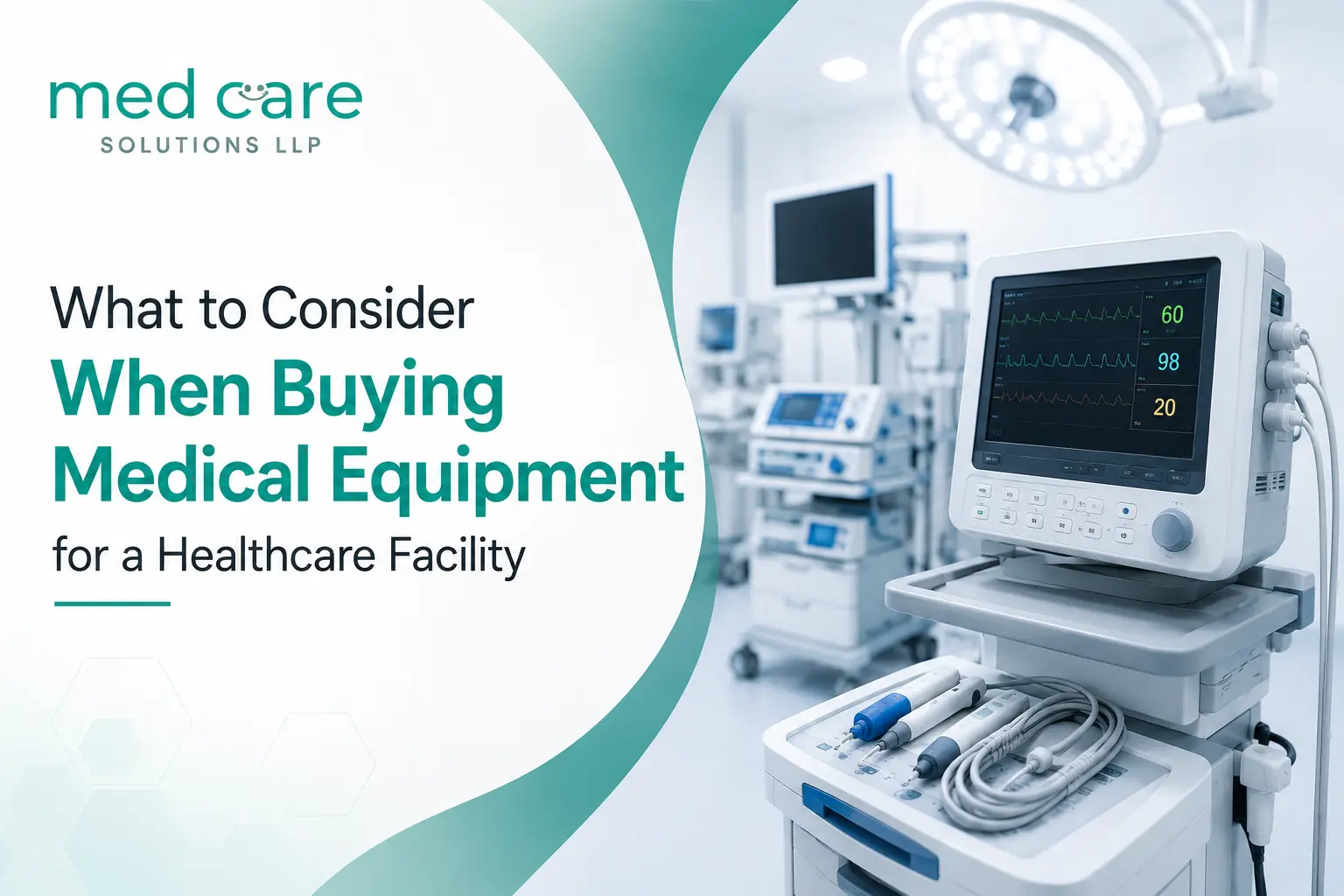
What to Consider When Buying Medical Equipment for a Healthcare Facility
What to Consider When Buying Medical Equipment for a Healthcare Facility
What to Consider When Buying Medical Equipment for a Healthcare Facility
Choosing the right medical equipment is an important decision for any healthcare facility. Whether you are setting up a new hospital, expanding a clinic, upgrading an existing facility, or replacing outdated equipment, the right products can directly influence workflow, patient care, staff efficiency, and long-term operating costs.
However, buying medical equipment is not simply about selecting products with the latest features. Healthcare facilities need to consider factors such as quality, intended use, safety, compatibility, maintenance, training, warranty, supplier support, and total cost of ownership.
With numerous medical equipment suppliers and products available in the market, knowing what to evaluate before making a purchase can help healthcare organizations make more informed decisions.
In this guide, we explore the key factors to consider when buying medical equipment for a healthcare facility.
1. Understand the Facility's Requirements
The first step is to identify exactly what your healthcare facility needs.
Different facilities have different requirements. A multispecialty hospital may require a wide range of advanced medical equipment, while a small clinic may need a more focused selection of essential devices.
Before purchasing, consider:
What type of healthcare facility are you operating?
Which departments will use the equipment?
What medical procedures will be performed?
How frequently will the equipment be used?
How many patients are expected to use the facility?
Is the equipment intended for diagnosis, monitoring, treatment, or support?
Are you replacing existing equipment or adding new capabilities?
Creating a detailed requirement list can prevent unnecessary purchases and help ensure that every piece of equipment serves a clear purpose.
2. Consider the Intended Use
Medical equipment should be selected according to its intended clinical application.
For example, equipment designed for a hospital intensive care unit may have very different specifications from equipment intended for a general consultation room.
Before choosing a product, clearly understand:
Its primary purpose
The clinical applications it supports
The type of patients it is designed for
The required operating environment
The expected workload
Whether it can support future requirements
Choosing equipment based on actual clinical needs rather than simply selecting the most advanced option can result in better value and more practical use.
3. Check Quality and Reliability
Quality is one of the most important considerations when purchasing medical equipment.
Healthcare facilities depend on equipment to perform consistently, sometimes in situations where failure can significantly affect patient care or clinical operations.
When evaluating equipment, look at:
Build quality
Product reliability
Manufacturer reputation
Expected service life
Performance consistency
Availability of replacement parts
Maintenance requirements
Manufacturer documentation
It is also important to consider whether the manufacturer has an established track record in the healthcare industry.
4. Verify Regulatory and Safety Requirements
Medical equipment should meet the applicable regulatory and safety requirements for its intended use and market.
Before purchasing, healthcare facilities should verify relevant certifications, approvals, documentation, and compliance requirements applicable to the particular equipment.
Depending on the product and its intended use, this may include checking:
Applicable Indian regulatory requirements
Manufacturer certifications
Product registration or licensing requirements, where applicable
Electrical and safety standards
Quality management certifications
Technical documentation
User manuals and safety instructions
For healthcare facilities in India, it is important to ensure that equipment is sourced through reliable suppliers and complies with applicable requirements.
5. Evaluate the Manufacturer
The manufacturer behind the equipment is just as important as the product itself.
A reputable manufacturer is more likely to provide reliable products, technical documentation, spare parts, software updates, training resources, and long-term support.
Consider researching:
Manufacturer experience
Product portfolio
Reputation among healthcare professionals
Quality standards
Warranty policies
Service network
Availability of spare parts
Technical support
Product lifecycle and upgrade options
Choosing a trusted manufacturer can reduce the risks associated with unreliable products and limited after-sales support.
6. Choose a Reliable Medical Equipment Supplier
Even high-quality equipment can become difficult to manage if the supplier does not provide adequate support.
A reliable medical equipment supplier should ideally offer more than just product delivery. Depending on the equipment and agreement, they may assist with installation, commissioning, training, maintenance, troubleshooting, and after-sales service.
Before choosing a supplier, consider:
Experience in the healthcare sector
Product knowledge
Manufacturer partnerships
Technical expertise
Installation capabilities
Training and user support
Warranty assistance
Availability of spare parts
Maintenance and service support
Responsiveness after purchase
For hospitals and clinics, having a dependable supplier can make the entire procurement process easier and more efficient.
7. Consider the Total Cost of Ownership
The purchase price is only one part of the overall cost of medical equipment.
A product with a lower initial price may become more expensive over time if it requires frequent repairs, expensive consumables, specialized maintenance, or costly replacement parts.
When evaluating the overall investment, consider:
Total cost of ownership = Purchase cost + Installation + Training + Maintenance + Consumables + Repairs + Upgrades
Other expenses may include:
Transportation
Infrastructure modifications
Software or licensing fees
Accessories
Replacement components
Preventive maintenance
Calibration
Technical support
Considering these costs before purchasing can provide a more realistic picture of the long-term investment.
8. Check Equipment Compatibility
Compatibility is an important consideration, particularly when introducing new equipment into an existing healthcare environment.
Before purchasing, check whether the equipment is compatible with:
Existing medical systems
Electrical infrastructure
IT networks
Hospital information systems
Patient monitoring systems
Data management platforms
Available physical space
Other equipment used in the same department
If the equipment requires special infrastructure or additional systems, these requirements should be identified before installation.
9. Evaluate Ease of Use
Medical equipment should be practical for the healthcare professionals who will use it.
Complex equipment may require extensive training and may slow down workflows if the interface is difficult to understand.
When evaluating usability, consider:
User interface
Controls and navigation
Display readability
Workflow integration
Accessibility
Ease of cleaning
Setup requirements
Training requirements
Availability of user manuals
Where possible, healthcare professionals who will actually operate the equipment should be involved in the selection process.
10. Consider Training Requirements
Even advanced medical equipment may not deliver its full value without proper training.
Healthcare professionals should understand how to operate equipment safely and correctly. Depending on the product, training may be required for doctors, nurses, technicians, biomedical engineers, or other staff.
Ask the supplier whether they provide:
Installation training
Operator training
Technical training
User manuals
Demonstrations
Troubleshooting guidance
Refresher training
Proper training can improve equipment utilization, reduce operational errors, and support safer use.
11. Review Warranty Coverage
Warranty terms can vary significantly between manufacturers and products.
Before purchasing medical equipment, carefully review the warranty conditions and understand what is included.
Check:
Warranty duration
Parts coverage
Labour coverage
Service response time
On-site support
Replacement conditions
Warranty exclusions
Repair procedures
Consumable exclusions
A clear understanding of warranty coverage can help avoid unexpected expenses later.
12. Ask About Maintenance and After-Sales Support
Medical equipment requires ongoing attention to remain reliable and functional.
Before making a purchase, ask the supplier about preventive maintenance, servicing, repairs, calibration, spare parts, and technical support.
Important questions include:
Is preventive maintenance available?
How quickly can technical issues be addressed?
Are spare parts readily available?
Is local service support available?
Can the supplier provide maintenance contracts?
How frequently does the equipment require servicing?
What happens if the equipment develops a major fault?
A supplier with strong after-sales support can provide greater confidence throughout the equipment's operating life.
13. Check Availability of Spare Parts and Consumables
Some medical equipment depends on specific accessories, consumables, replacement components, or proprietary parts.
Before purchasing, confirm:
Availability of essential consumables
Cost of consumables
Availability of replacement parts
Expected availability over the product lifecycle
Lead time for imported components
Whether compatible alternatives are available
A product may seem cost-effective initially but become difficult or expensive to operate if essential components are difficult to source.
14. Consider Energy and Infrastructure Requirements
Some medical equipment may require specific electrical, environmental, or infrastructure conditions.
Before installation, determine whether your facility has the necessary:
Electrical supply
Power backup
Ventilation
Temperature control
Water supply
Drainage
Network connectivity
Floor space
Structural support
Infection-control arrangements
Discuss installation requirements with the supplier in advance so that necessary infrastructure modifications can be completed before delivery.
15. Think About Space and Workflow
The physical size and placement of medical equipment can influence the efficiency of a healthcare facility.
Before purchasing, evaluate:
Equipment dimensions
Installation space
Operator access
Patient movement
Staff workflow
Cleaning access
Maintenance access
Storage requirements
Emergency access
Equipment should be positioned in a way that supports safe and efficient movement for both healthcare professionals and patients.
16. Evaluate Technology and Future Upgrades
Healthcare technology continues to evolve. Therefore, it can be useful to consider whether equipment can adapt to future requirements.
Depending on the product, check whether it supports:
Software updates
System upgrades
Additional accessories
New features
Data integration
Connectivity with other systems
Expansion of capacity
Buying equipment with reasonable upgrade potential may help healthcare facilities avoid replacing entire systems when their requirements change.
17. Consider Data Security and Connectivity
Modern medical equipment increasingly connects to hospital networks, computers, cloud systems, or other digital platforms.
If the equipment collects, stores, or transfers patient or clinical data, healthcare facilities should consider cybersecurity and data protection requirements.
Evaluate:
User access controls
Authentication features
Data encryption
Software update support
Network security
Data storage
Backup procedures
Integration with existing systems
Healthcare organizations should ensure that connected equipment is implemented according to their internal cybersecurity and data protection policies.
18. Compare Products Before Making a Decision
Avoid selecting the first product you find.
Compare multiple suitable options based on factors such as:
Factor | What to Compare |
Quality | Build quality and reliability |
Features | Clinical and operational capabilities |
Cost | Purchase and long-term expenses |
Warranty | Coverage and duration |
Service | Technical and maintenance support |
Training | Availability and scope |
Consumables | Cost and availability |
Compatibility | Integration with existing systems |
Manufacturer | Reputation and experience |
Upgradeability | Future expansion and updates |
A structured comparison makes it easier to identify which equipment provides the right balance of quality, functionality, and long-term value.
19. Request a Product Demonstration
For complex or high-value medical equipment, a demonstration can be extremely useful before making a purchase decision.
A demonstration allows healthcare professionals to evaluate:
Ease of operation
Product features
Workflow compatibility
User interface
Performance
Practical limitations
Training requirements
Whenever possible, allow the actual users of the equipment to participate in the demonstration and provide feedback.
20. Consider Installation and Commissioning
Buying medical equipment is only the beginning. Proper installation and commissioning are essential for many types of equipment.
Ask the supplier about:
Delivery requirements
Installation
Equipment setup
Calibration
Testing
Commissioning
Staff training
Documentation
Handover procedures
Professional installation can help ensure that equipment is set up correctly and ready for intended use.
21. Review Documentation
Before accepting medical equipment, make sure you receive the relevant documentation.
Depending on the equipment, this may include:
User manuals
Technical manuals
Warranty documents
Installation records
Calibration certificates
Compliance documentation
Maintenance schedules
Service records
Training certificates
Product specifications
Proper documentation can be valuable for equipment management, maintenance, audits, and staff training.
22. Consider the Supplier's Location and Service Network
For healthcare facilities, quick access to technical support can be important when equipment is unavailable due to a fault.
A supplier with an established service network can potentially provide faster assistance than a supplier with limited local support.
When comparing suppliers, consider:
Service locations
Response times
Technical staff availability
Spare-parts access
Remote support
On-site service
Emergency support options
For healthcare facilities in Kerala, choosing a medical equipment supplier with dependable regional support can be especially valuable.
23. Do Not Focus Only on the Lowest Price
Cost is important, but the lowest purchase price does not necessarily represent the best value.
An inexpensive product may involve higher maintenance costs, shorter service life, limited technical support, or difficult-to-source parts.
Instead of asking only, "How much does it cost?", consider:
Does this equipment provide reliable performance and long-term value for our facility?
A balanced purchasing decision should consider quality, safety, performance, service, support, and total cost of ownership.
24. Create a Medical Equipment Procurement Checklist
Before finalizing a purchase, healthcare facilities can use a checklist such as:
Medical Equipment Buying Checklist
Define the clinical requirement
Identify intended users
Check product specifications
Verify applicable regulatory requirements
Evaluate manufacturer reputation
Compare multiple products
Compare suppliers
Review total cost of ownership
Check warranty coverage
Confirm spare-parts availability
Confirm consumable availability
Evaluate installation requirements
Check infrastructure compatibility
Review training options
Ask about maintenance and service
Evaluate upgrade possibilities
Consider data security for connected equipment
Request a demonstration when appropriate
Review documentation
Confirm delivery and installation timelines
Common Mistakes to Avoid When Buying Medical Equipment
Healthcare facilities can avoid several common procurement mistakes by planning carefully.
Choosing Based Only on Price
The cheapest product may not offer the best long-term value. Always consider maintenance, consumables, service, and expected lifespan.
Ignoring After-Sales Support
Even reliable equipment may eventually require servicing. Make sure technical support is available after purchase.
Not Checking Compatibility
New equipment may require specific infrastructure or integration capabilities. Confirm compatibility before placing an order.
Buying Without User Feedback
Doctors, nurses, technicians, and other users can provide valuable insights into equipment usability and workflow.
Overlooking Training
Proper training is essential for effective and safe operation of many types of medical equipment.
Failing to Review Warranty Terms
Understand what is covered, what is excluded, and how service requests are handled before purchasing.
Not Planning for Maintenance
Equipment should be supported throughout its lifecycle. Ask about preventive maintenance and servicing before finalizing the purchase.
Why the Right Medical Equipment Supplier Matters
The supplier you choose can influence your experience long after the equipment has been delivered.
A dependable supplier can help healthcare facilities with product selection, technical consultation, installation, training, maintenance, troubleshooting, and after-sales support.
For this reason, healthcare facilities should evaluate suppliers based on their product knowledge, manufacturer relationships, technical capabilities, service support, and commitment to customer satisfaction, rather than simply comparing product prices.
Final Thoughts
Buying medical equipment is a significant decision for any healthcare facility. The right choice should balance clinical requirements, quality, safety, usability, regulatory considerations, compatibility, cost, maintenance, and long-term support.
Before making a purchase, healthcare organizations should clearly define their requirements, compare suitable products, evaluate manufacturers and suppliers, review warranty and service terms, and consider the total cost of ownership.
Most importantly, medical equipment should be viewed as a long-term investment in healthcare delivery rather than simply a one-time purchase.
Working with an experienced and reliable medical equipment supplier can make the procurement process easier while helping healthcare facilities obtain suitable equipment and dependable support throughout its lifecycle.
As the best medical equipment supplier in India, Med Care Solutions LLP provides medical equipment and healthcare solutions with support ranging from equipment supply to installation, training, and ongoing assistance. With experience in the healthcare industry and partnerships with recognized manufacturers, we help healthcare facilities make informed equipment decisions based on their specific requirements.
If you are planning to purchase medical equipment for a hospital, clinic, or other healthcare facility, contact Med Care Solutions LLP to discuss your requirements and explore suitable healthcare equipment solutions.
Frequently Asked Questions
What should I consider when buying medical equipment?
Consider the equipment's intended use, quality, safety, regulatory requirements, manufacturer reputation, supplier support, warranty, maintenance, compatibility, training, consumables, and total cost of ownership.
How do I choose a medical equipment supplier?
Look for a supplier with healthcare industry experience, reliable manufacturer partnerships, technical expertise, installation capabilities, training services, warranty support, spare-parts availability, and dependable after-sales service.
Why is after-sales support important for medical equipment?
Medical equipment may require installation, preventive maintenance, repairs, calibration, replacement parts, software updates, or technical assistance. Reliable after-sales support helps healthcare facilities maintain equipment performance over time.
Should I consider the total cost of medical equipment?
Yes. The purchase price is only one part of the investment. Installation, training, maintenance, consumables, repairs, spare parts, upgrades, and other operating expenses should also be considered.
Is it important to compare different medical equipment brands?
Yes. Comparing products and manufacturers can help healthcare facilities evaluate differences in features, quality, reliability, warranty, service, compatibility, and long-term operating costs.
Do healthcare professionals need training to use medical equipment?
Training requirements depend on the type and complexity of the equipment. For many medical devices, proper training helps users understand operation, safety procedures, maintenance requirements, and appropriate use.
How often should medical equipment be maintained?
Maintenance schedules vary by equipment type, manufacturer recommendations, usage, and applicable requirements. Healthcare facilities should follow the manufacturer's recommended maintenance and servicing schedule.
Why should healthcare facilities choose quality medical equipment?
Reliable medical equipment can support consistent clinical workflows, patient care, staff efficiency, and long-term operational value. Quality should be evaluated alongside safety, performance, support, and lifecycle costs.
Choosing the right medical equipment is an important decision for any healthcare facility. Whether you are setting up a new hospital, expanding a clinic, upgrading an existing facility, or replacing outdated equipment, the right products can directly influence workflow, patient care, staff efficiency, and long-term operating costs.
However, buying medical equipment is not simply about selecting products with the latest features. Healthcare facilities need to consider factors such as quality, intended use, safety, compatibility, maintenance, training, warranty, supplier support, and total cost of ownership.
With numerous medical equipment suppliers and products available in the market, knowing what to evaluate before making a purchase can help healthcare organizations make more informed decisions.
In this guide, we explore the key factors to consider when buying medical equipment for a healthcare facility.
1. Understand the Facility's Requirements
The first step is to identify exactly what your healthcare facility needs.
Different facilities have different requirements. A multispecialty hospital may require a wide range of advanced medical equipment, while a small clinic may need a more focused selection of essential devices.
Before purchasing, consider:
What type of healthcare facility are you operating?
Which departments will use the equipment?
What medical procedures will be performed?
How frequently will the equipment be used?
How many patients are expected to use the facility?
Is the equipment intended for diagnosis, monitoring, treatment, or support?
Are you replacing existing equipment or adding new capabilities?
Creating a detailed requirement list can prevent unnecessary purchases and help ensure that every piece of equipment serves a clear purpose.
2. Consider the Intended Use
Medical equipment should be selected according to its intended clinical application.
For example, equipment designed for a hospital intensive care unit may have very different specifications from equipment intended for a general consultation room.
Before choosing a product, clearly understand:
Its primary purpose
The clinical applications it supports
The type of patients it is designed for
The required operating environment
The expected workload
Whether it can support future requirements
Choosing equipment based on actual clinical needs rather than simply selecting the most advanced option can result in better value and more practical use.
3. Check Quality and Reliability
Quality is one of the most important considerations when purchasing medical equipment.
Healthcare facilities depend on equipment to perform consistently, sometimes in situations where failure can significantly affect patient care or clinical operations.
When evaluating equipment, look at:
Build quality
Product reliability
Manufacturer reputation
Expected service life
Performance consistency
Availability of replacement parts
Maintenance requirements
Manufacturer documentation
It is also important to consider whether the manufacturer has an established track record in the healthcare industry.
4. Verify Regulatory and Safety Requirements
Medical equipment should meet the applicable regulatory and safety requirements for its intended use and market.
Before purchasing, healthcare facilities should verify relevant certifications, approvals, documentation, and compliance requirements applicable to the particular equipment.
Depending on the product and its intended use, this may include checking:
Applicable Indian regulatory requirements
Manufacturer certifications
Product registration or licensing requirements, where applicable
Electrical and safety standards
Quality management certifications
Technical documentation
User manuals and safety instructions
For healthcare facilities in India, it is important to ensure that equipment is sourced through reliable suppliers and complies with applicable requirements.
5. Evaluate the Manufacturer
The manufacturer behind the equipment is just as important as the product itself.
A reputable manufacturer is more likely to provide reliable products, technical documentation, spare parts, software updates, training resources, and long-term support.
Consider researching:
Manufacturer experience
Product portfolio
Reputation among healthcare professionals
Quality standards
Warranty policies
Service network
Availability of spare parts
Technical support
Product lifecycle and upgrade options
Choosing a trusted manufacturer can reduce the risks associated with unreliable products and limited after-sales support.
6. Choose a Reliable Medical Equipment Supplier
Even high-quality equipment can become difficult to manage if the supplier does not provide adequate support.
A reliable medical equipment supplier should ideally offer more than just product delivery. Depending on the equipment and agreement, they may assist with installation, commissioning, training, maintenance, troubleshooting, and after-sales service.
Before choosing a supplier, consider:
Experience in the healthcare sector
Product knowledge
Manufacturer partnerships
Technical expertise
Installation capabilities
Training and user support
Warranty assistance
Availability of spare parts
Maintenance and service support
Responsiveness after purchase
For hospitals and clinics, having a dependable supplier can make the entire procurement process easier and more efficient.
7. Consider the Total Cost of Ownership
The purchase price is only one part of the overall cost of medical equipment.
A product with a lower initial price may become more expensive over time if it requires frequent repairs, expensive consumables, specialized maintenance, or costly replacement parts.
When evaluating the overall investment, consider:
Total cost of ownership = Purchase cost + Installation + Training + Maintenance + Consumables + Repairs + Upgrades
Other expenses may include:
Transportation
Infrastructure modifications
Software or licensing fees
Accessories
Replacement components
Preventive maintenance
Calibration
Technical support
Considering these costs before purchasing can provide a more realistic picture of the long-term investment.
8. Check Equipment Compatibility
Compatibility is an important consideration, particularly when introducing new equipment into an existing healthcare environment.
Before purchasing, check whether the equipment is compatible with:
Existing medical systems
Electrical infrastructure
IT networks
Hospital information systems
Patient monitoring systems
Data management platforms
Available physical space
Other equipment used in the same department
If the equipment requires special infrastructure or additional systems, these requirements should be identified before installation.
9. Evaluate Ease of Use
Medical equipment should be practical for the healthcare professionals who will use it.
Complex equipment may require extensive training and may slow down workflows if the interface is difficult to understand.
When evaluating usability, consider:
User interface
Controls and navigation
Display readability
Workflow integration
Accessibility
Ease of cleaning
Setup requirements
Training requirements
Availability of user manuals
Where possible, healthcare professionals who will actually operate the equipment should be involved in the selection process.
10. Consider Training Requirements
Even advanced medical equipment may not deliver its full value without proper training.
Healthcare professionals should understand how to operate equipment safely and correctly. Depending on the product, training may be required for doctors, nurses, technicians, biomedical engineers, or other staff.
Ask the supplier whether they provide:
Installation training
Operator training
Technical training
User manuals
Demonstrations
Troubleshooting guidance
Refresher training
Proper training can improve equipment utilization, reduce operational errors, and support safer use.
11. Review Warranty Coverage
Warranty terms can vary significantly between manufacturers and products.
Before purchasing medical equipment, carefully review the warranty conditions and understand what is included.
Check:
Warranty duration
Parts coverage
Labour coverage
Service response time
On-site support
Replacement conditions
Warranty exclusions
Repair procedures
Consumable exclusions
A clear understanding of warranty coverage can help avoid unexpected expenses later.
12. Ask About Maintenance and After-Sales Support
Medical equipment requires ongoing attention to remain reliable and functional.
Before making a purchase, ask the supplier about preventive maintenance, servicing, repairs, calibration, spare parts, and technical support.
Important questions include:
Is preventive maintenance available?
How quickly can technical issues be addressed?
Are spare parts readily available?
Is local service support available?
Can the supplier provide maintenance contracts?
How frequently does the equipment require servicing?
What happens if the equipment develops a major fault?
A supplier with strong after-sales support can provide greater confidence throughout the equipment's operating life.
13. Check Availability of Spare Parts and Consumables
Some medical equipment depends on specific accessories, consumables, replacement components, or proprietary parts.
Before purchasing, confirm:
Availability of essential consumables
Cost of consumables
Availability of replacement parts
Expected availability over the product lifecycle
Lead time for imported components
Whether compatible alternatives are available
A product may seem cost-effective initially but become difficult or expensive to operate if essential components are difficult to source.
14. Consider Energy and Infrastructure Requirements
Some medical equipment may require specific electrical, environmental, or infrastructure conditions.
Before installation, determine whether your facility has the necessary:
Electrical supply
Power backup
Ventilation
Temperature control
Water supply
Drainage
Network connectivity
Floor space
Structural support
Infection-control arrangements
Discuss installation requirements with the supplier in advance so that necessary infrastructure modifications can be completed before delivery.
15. Think About Space and Workflow
The physical size and placement of medical equipment can influence the efficiency of a healthcare facility.
Before purchasing, evaluate:
Equipment dimensions
Installation space
Operator access
Patient movement
Staff workflow
Cleaning access
Maintenance access
Storage requirements
Emergency access
Equipment should be positioned in a way that supports safe and efficient movement for both healthcare professionals and patients.
16. Evaluate Technology and Future Upgrades
Healthcare technology continues to evolve. Therefore, it can be useful to consider whether equipment can adapt to future requirements.
Depending on the product, check whether it supports:
Software updates
System upgrades
Additional accessories
New features
Data integration
Connectivity with other systems
Expansion of capacity
Buying equipment with reasonable upgrade potential may help healthcare facilities avoid replacing entire systems when their requirements change.
17. Consider Data Security and Connectivity
Modern medical equipment increasingly connects to hospital networks, computers, cloud systems, or other digital platforms.
If the equipment collects, stores, or transfers patient or clinical data, healthcare facilities should consider cybersecurity and data protection requirements.
Evaluate:
User access controls
Authentication features
Data encryption
Software update support
Network security
Data storage
Backup procedures
Integration with existing systems
Healthcare organizations should ensure that connected equipment is implemented according to their internal cybersecurity and data protection policies.
18. Compare Products Before Making a Decision
Avoid selecting the first product you find.
Compare multiple suitable options based on factors such as:
Factor | What to Compare |
Quality | Build quality and reliability |
Features | Clinical and operational capabilities |
Cost | Purchase and long-term expenses |
Warranty | Coverage and duration |
Service | Technical and maintenance support |
Training | Availability and scope |
Consumables | Cost and availability |
Compatibility | Integration with existing systems |
Manufacturer | Reputation and experience |
Upgradeability | Future expansion and updates |
A structured comparison makes it easier to identify which equipment provides the right balance of quality, functionality, and long-term value.
19. Request a Product Demonstration
For complex or high-value medical equipment, a demonstration can be extremely useful before making a purchase decision.
A demonstration allows healthcare professionals to evaluate:
Ease of operation
Product features
Workflow compatibility
User interface
Performance
Practical limitations
Training requirements
Whenever possible, allow the actual users of the equipment to participate in the demonstration and provide feedback.
20. Consider Installation and Commissioning
Buying medical equipment is only the beginning. Proper installation and commissioning are essential for many types of equipment.
Ask the supplier about:
Delivery requirements
Installation
Equipment setup
Calibration
Testing
Commissioning
Staff training
Documentation
Handover procedures
Professional installation can help ensure that equipment is set up correctly and ready for intended use.
21. Review Documentation
Before accepting medical equipment, make sure you receive the relevant documentation.
Depending on the equipment, this may include:
User manuals
Technical manuals
Warranty documents
Installation records
Calibration certificates
Compliance documentation
Maintenance schedules
Service records
Training certificates
Product specifications
Proper documentation can be valuable for equipment management, maintenance, audits, and staff training.
22. Consider the Supplier's Location and Service Network
For healthcare facilities, quick access to technical support can be important when equipment is unavailable due to a fault.
A supplier with an established service network can potentially provide faster assistance than a supplier with limited local support.
When comparing suppliers, consider:
Service locations
Response times
Technical staff availability
Spare-parts access
Remote support
On-site service
Emergency support options
For healthcare facilities in Kerala, choosing a medical equipment supplier with dependable regional support can be especially valuable.
23. Do Not Focus Only on the Lowest Price
Cost is important, but the lowest purchase price does not necessarily represent the best value.
An inexpensive product may involve higher maintenance costs, shorter service life, limited technical support, or difficult-to-source parts.
Instead of asking only, "How much does it cost?", consider:
Does this equipment provide reliable performance and long-term value for our facility?
A balanced purchasing decision should consider quality, safety, performance, service, support, and total cost of ownership.
24. Create a Medical Equipment Procurement Checklist
Before finalizing a purchase, healthcare facilities can use a checklist such as:
Medical Equipment Buying Checklist
Define the clinical requirement
Identify intended users
Check product specifications
Verify applicable regulatory requirements
Evaluate manufacturer reputation
Compare multiple products
Compare suppliers
Review total cost of ownership
Check warranty coverage
Confirm spare-parts availability
Confirm consumable availability
Evaluate installation requirements
Check infrastructure compatibility
Review training options
Ask about maintenance and service
Evaluate upgrade possibilities
Consider data security for connected equipment
Request a demonstration when appropriate
Review documentation
Confirm delivery and installation timelines
Common Mistakes to Avoid When Buying Medical Equipment
Healthcare facilities can avoid several common procurement mistakes by planning carefully.
Choosing Based Only on Price
The cheapest product may not offer the best long-term value. Always consider maintenance, consumables, service, and expected lifespan.
Ignoring After-Sales Support
Even reliable equipment may eventually require servicing. Make sure technical support is available after purchase.
Not Checking Compatibility
New equipment may require specific infrastructure or integration capabilities. Confirm compatibility before placing an order.
Buying Without User Feedback
Doctors, nurses, technicians, and other users can provide valuable insights into equipment usability and workflow.
Overlooking Training
Proper training is essential for effective and safe operation of many types of medical equipment.
Failing to Review Warranty Terms
Understand what is covered, what is excluded, and how service requests are handled before purchasing.
Not Planning for Maintenance
Equipment should be supported throughout its lifecycle. Ask about preventive maintenance and servicing before finalizing the purchase.
Why the Right Medical Equipment Supplier Matters
The supplier you choose can influence your experience long after the equipment has been delivered.
A dependable supplier can help healthcare facilities with product selection, technical consultation, installation, training, maintenance, troubleshooting, and after-sales support.
For this reason, healthcare facilities should evaluate suppliers based on their product knowledge, manufacturer relationships, technical capabilities, service support, and commitment to customer satisfaction, rather than simply comparing product prices.
Final Thoughts
Buying medical equipment is a significant decision for any healthcare facility. The right choice should balance clinical requirements, quality, safety, usability, regulatory considerations, compatibility, cost, maintenance, and long-term support.
Before making a purchase, healthcare organizations should clearly define their requirements, compare suitable products, evaluate manufacturers and suppliers, review warranty and service terms, and consider the total cost of ownership.
Most importantly, medical equipment should be viewed as a long-term investment in healthcare delivery rather than simply a one-time purchase.
Working with an experienced and reliable medical equipment supplier can make the procurement process easier while helping healthcare facilities obtain suitable equipment and dependable support throughout its lifecycle.
As the best medical equipment supplier in India, Med Care Solutions LLP provides medical equipment and healthcare solutions with support ranging from equipment supply to installation, training, and ongoing assistance. With experience in the healthcare industry and partnerships with recognized manufacturers, we help healthcare facilities make informed equipment decisions based on their specific requirements.
If you are planning to purchase medical equipment for a hospital, clinic, or other healthcare facility, contact Med Care Solutions LLP to discuss your requirements and explore suitable healthcare equipment solutions.
Frequently Asked Questions
What should I consider when buying medical equipment?
Consider the equipment's intended use, quality, safety, regulatory requirements, manufacturer reputation, supplier support, warranty, maintenance, compatibility, training, consumables, and total cost of ownership.
How do I choose a medical equipment supplier?
Look for a supplier with healthcare industry experience, reliable manufacturer partnerships, technical expertise, installation capabilities, training services, warranty support, spare-parts availability, and dependable after-sales service.
Why is after-sales support important for medical equipment?
Medical equipment may require installation, preventive maintenance, repairs, calibration, replacement parts, software updates, or technical assistance. Reliable after-sales support helps healthcare facilities maintain equipment performance over time.
Should I consider the total cost of medical equipment?
Yes. The purchase price is only one part of the investment. Installation, training, maintenance, consumables, repairs, spare parts, upgrades, and other operating expenses should also be considered.
Is it important to compare different medical equipment brands?
Yes. Comparing products and manufacturers can help healthcare facilities evaluate differences in features, quality, reliability, warranty, service, compatibility, and long-term operating costs.
Do healthcare professionals need training to use medical equipment?
Training requirements depend on the type and complexity of the equipment. For many medical devices, proper training helps users understand operation, safety procedures, maintenance requirements, and appropriate use.
How often should medical equipment be maintained?
Maintenance schedules vary by equipment type, manufacturer recommendations, usage, and applicable requirements. Healthcare facilities should follow the manufacturer's recommended maintenance and servicing schedule.
Why should healthcare facilities choose quality medical equipment?
Reliable medical equipment can support consistent clinical workflows, patient care, staff efficiency, and long-term operational value. Quality should be evaluated alongside safety, performance, support, and lifecycle costs.
Get Started Today
Reliable Service You Can Trust
Fast, certified repair, maintenance, and refurbishment for ultrasound systems and probes.
100% ISO Certified
98% Client Satisfaction
99% On-Time Delivery
Join 500+ healthcare facilities trusting Med Care Solutions
Get Started Today
Reliable Service You Can Trust
Fast, certified repair, maintenance, and refurbishment for ultrasound systems and probes.
100% ISO Certified
98% Client Satisfaction
99% On-Time Delivery
Join 500+ healthcare facilities trusting Med Care Solutions
Get Started Today
Reliable Service You Can Trust
Fast, certified repair, maintenance, and refurbishment for ultrasound systems and probes.
100% ISO Certified
98% Client Satisfaction
99% On-Time Delivery
Join 500+ healthcare facilities trusting Med Care Solutions